
Introduction
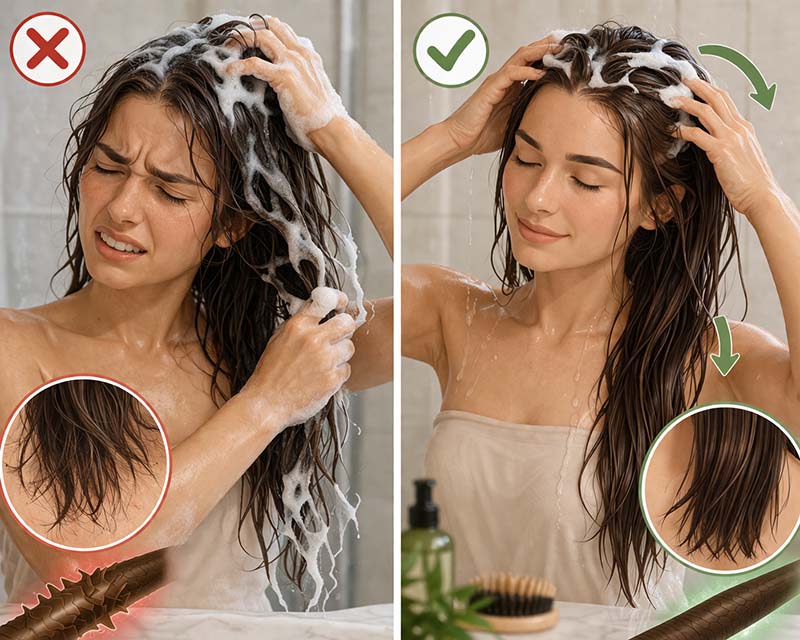
Many people put shampoo on All hair from Root to tip And they rub it vigorously, because they think that this is the right cleaning.
But the important question is: Does applying shampoo to the ends of the hair actually cause dryness?
The fact is that the shampoo is mainly designed for cleaning The scalp And remove fat and accumulations from them, not to rub the ends directly and roughly at every wash.
Therefore, the wrong handling of shampoo may cause over time Dryness of the ends, roughness of the hair, increased brittleness،
Especially if the hair was originally dry, dyed or tired.In this article we will simply show you the truth, why the ends of the hair may be damaged by the washing method, and what is the correct way to use shampoo without causing unnecessary dryness.
First: does shampoo cause dryness of the ends of the hair?
Yes، May cause dehydration If used on the ends directly, repeatedly and in a strong manner.
Why?
Because the ends of the hair:
- The oldest part of the poem
- The least part gets natural oils
- More prone to dryness and brittleness
- Weaker than the roots and scalp
And when the shampoo hits it hard every time
It may become:
- Drier and drier
- More rough
- Faster splitting
- Harder to style
- More hishana after washing
Second: what part of the shampoo really needs?
The part that basically needs shampoo is The scalpBecause it's where you gather:
- Fatness
- Race
- Leftover products
- Everyday dirt
The ends
They usually do not need the same level of vigorous cleaning, because what they get while rinsing the shampoo is often enough, especially if they are dry or sensitive.💡 The simple rule:
Shampoos for cleaning The scalp Firstly, not to rub the ends vigorously at every wash.
Third: when is the damage greater on the ends?
Not all hair types are affected to the same degree, but some cases are more sensitive.
The damage is greater if the hair:
- Java
- Retarded
- Painted
- Curly or corrugated
- Long and tired ends
- Damaged by heat or styling
The damage also increases if:
- The shampoo was too strong
- The ends were rubbed violently
- Washing was frequent
- Use very hot water
- Hair is not moistened after washing
Signs that the ends of your hair are damaged by the way you use shampoo
Sometimes a person thinks that the problem is from the weather or just from the type of hair, while the real reason is in the way of washing.
Common signs:
- Pronounced dryness after bathing
- Roughness of the ends
- frizz after the hair dries
- More entanglement than usual
- Constant split ends
- Loss of smoothness and shine
If you notice these signs
It may need to be modified How to apply shampoo And not just change the product.
How do you know that the problem is from the washing method?
Ask yourself these questions:
- Do you rub the ends with shampoo directly at each wash?
- Does your hair become dry after a shower?
- Do the ends look weaker than the rest of the hair?
- Do you use hot water or strong shampoo?
If the answer is yes
Often the ends of your hair are damaged not only by shampoo, but by How to use it Also.
Reasons that make the problem bigger
Sometimes the reason is not from just one step, but from several combined habits.
Common causes:
- Apply shampoo to all hair thickly
- Rubbing the ends vigorously
- Use of hot water
- Frequent washing too often
- Not using proper hydration
- Use heat immediately after washing
- Neglect of cutting damaged ends
What is the correct way to use shampoo?
The right method helps you clean the scalp without drawing moisture from the ends too much.
The right way:
- Moisten the hair well
- Apply shampoo to The scalp
- Gently massage the scalp with fingertips
- Do not rub the ends violently
- Let the shampoo foam come down with the rinse on the rest of the hair
- Gently wash hair without tightening
- Take care of the ends after washing with proper hydration
Objective:
Effectively clean the scalp, while minimizing the dryness of the ends as much as possible.
Does all hair need the same amount of shampoo?
No, the quantity varies according to:
- Hair density
- Hair length
- The amount of fat in the scalp
- Number of washings
But the important
Not only the amount of shampoo, but Where to put it and how to use it.
Even if the quantity is appropriate, the problem may occur if the method is harsh on the ends.
Is it possible to clean the hair without hurting the ends?
Yes, absolutely.
How?:
- Focus on the scalp
- Use lukewarm water
- Do not overdo the rubbing
- Do not prolong the washing time unnecessarily
- Apply proper hydration to the ends
- Treat hair after washing gently
The result
Clean scalp, more balanced hair, less dry and brittle ends.
Adivasi routine to support hair if the ends are dry
If the ends of your hair suffer from dryness or split ends, it is important that the routine is balanced from washing to caring after it.
Proper routine:
- Gently cleanse the scalp
- Do not rub the ends with shampoo directly
- Use Adivasi oil on areas that need attention
- Focus on the ends if they are dry or split
- Reduce heat and violence after washing
- Adhere to a consistent and gentle routine
If the problem is in the ends
Focus on hydration, reducing dryness and friction.
If the problem is in the scalp
Focus on cleaning the scalp well without negatively reflecting on the length of the hair.
Common mistakes
- Apply shampoo directly to the ends every time
- Rubbing the whole hair violently
- Use very hot water
- Neglecting moisturizing the ends after washing
- Using a strong shampoo with already dry hair
- The belief that more foam means better cleaning
- Ignoring that the ends need gentler treatment than the scalp
Conclusion
Yes، Applying shampoo to the ends of the hair in a direct and harsh way may cause dryness, Especially if the hair is dry, brittle or dyed.
Therefore, it is better to make a shampoo aimed mainly at The scalp, And to handle the ends more gently during washing.Sometimes to improve the health of hair does not need to change all the products, it just needs Modification of the method of use In the daily routine.
Frequently asked questions (FAQ)
Should the ends of the hair always be shampooed?
Not necessarily directly and strongly every time, it is often enough to reach for it while rinsing the shampoo from the scalp, especially if the ends are dry.
Does shampoo cause split ends?
It may not be the only reason, but it may increase dehydration, which over time leads to limb weakness and brittleness if used in the wrong way.
When do I see a difference if I change the washing method?
Often, a difference in dryness, brittleness and texture of the ends can be noticed within weeks with adherence to a gentler method and an appropriate routine.
Conclusion
Often, the problem is not in the shampoo itself, but in Where we put it and the way we use it.
And when you focus on gently cleansing the scalp, protecting the ends from overdrying, over time you will notice that your hair becomes softer, more balanced and less prone to breakage.
Order Adivasi herbal oil now: