
Caring for hair under the veil needs a different routine than for uncovered hair throughout the day.
The hair under the veil may be exposed to friction, sweating, lack of ventilation, constant tying, and dryness at the ends.
Over time, you may notice that the hair has become more brittle, the ends have become dry, or the roots have quickly become greasy.And here an important question arises:
Can Adivasi oil be used for hair under the veil without causing greasy or unpleasant odor?
The short answer is: Yes, Adivasi oil can be used for hair under the veil in an appropriate way, but it is better to use it before washing, and in a balanced amount, focusing on the ends and the middle of the hair instead of the roots, so that the hair does not become heavy or greasy under the veil.
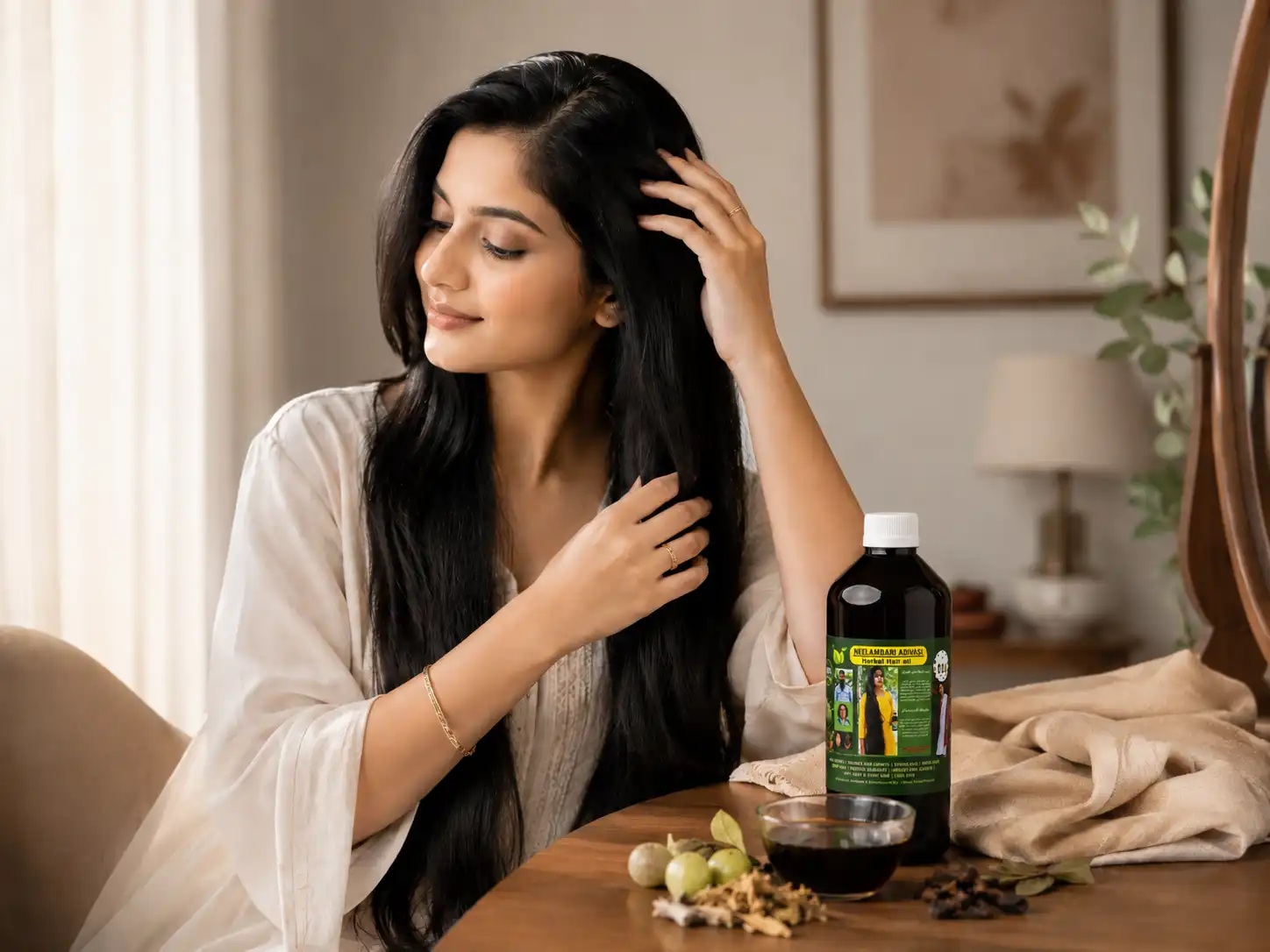
In this article you will learn about the correct way to use tribal Adivasi Herbal Hair Oil 108 herbs under the veil, how to choose the right amount depending on your hair type, and what mistakes to avoid so that the oil experience remains comfortable and effective.
Why hair under the veil needs special care?
The hair under the hijab is covered for long periods during the day, and this may make it more prone to sweating and friction, especially if it is tightly tied or if the fabric is not suitable. Also, the ends may dry out with time due to lack of ventilation or frequent styling.Some women notice that the scalp quickly becomes oily, while the ends remain dry and brittle.
And this type of hair needs a balanced routine, because using oil in a random way may increase the oiliness of the roots, while completely ignoring the oil may leave the ends dry and tired.Therefore, Adivasi oil can be a useful step, but on condition that it is used in the right place and in the right amount.
Is adivasi oil suitable for hair under the veil?
Adivasi oil may be suitable for hair under the veil if the goal is to take care of dry ends, reduce the appearance of frizz, improve hair texture, and facilitate styling. But using it after washing or directly on the roots may not suit everyone, especially if the hair is thin or the scalp is oily.
The best for most veiled women is to use the oil before taking a shower, and then wash it well, so that the hair benefits from the care without the oil remaining on the hair all day under the veil.
This way you get the benefit of the oil without a greasy appearance, heaviness or unpleasant odor.
When is the best time to use Adivasi oil under the veil?
The best time to use Adivasi oil for hair under the veil is at a time when you are able to wash the hair after it, such as two or three hours before bathing. This method is convenient because it gives the hair enough time to care, and then the excess oil is washed off before wearing it.If you are going to go out or stay with a veil for long hours, it is not preferable to apply oil to the hair immediately before going out, especially on the roots or scalp.
Because this can make the hair greasy, and the sensation of heaviness or smell may increase with sweating.The best routine is to use the oil on the care day, not the long day off or work if you don't have time to wash the hair.
How to use Adivasi oil for hair under the veil
Start with a small amount of Adivasi oil, then distribute it between the palms of the hands so that it is not concentrated in one area. After that, pass the oil on the ends of the hair and the middle of the hair to the bottom, especially dry or brittle areas.
If you have long or thick hair, you can divide it into simple parts so that the oil reaches the inner strands. As for whether your hair is light or soft, it is better to use a very small amount and focus only on the ends.
Leave the oil one to three hours before washing, then wash the hair thoroughly with shampoo. After washing, gently dry the hair and do not wear a hijab and the hair is completely wet, as moisture under the hijab may cause an uncomfortable smell or a feeling of heaviness.
Why is it better to apply oil before washing and not after?
The use of Adivasi oil before washing is the most suitable option for hair under the veil, because the oil gives the hair care, and then the excess is removed from it with shampoo. This makes the hair calmer and gentler in texture without the oil remaining on the hair all day.As for applying oil after washing, it may suit some types of very dry or thick hair, but under the veil it may be uncomfortable if the amount increases.
Oil left on the hair with sweating and friction may make the hair look greasy or cause an unpleasant odor.Therefore, if you are veiled and want to use the oil safely, make the basic method is before washing, and not after.
Is adivasi oil applied to the scalp under the veil?
In most cases, you do not need to apply Adivasi oil to the scalp if the goal is to reduce brittleness or dryness of the ends. The scalp under the veil may quickly become oily due to sweating or lack of ventilation, so applying oil to it may increase heaviness in some women.
If your scalp is normal, non-greasy and does not suffer from itching or dandruff, a very small amount can be tried on the scalp before washing, with a gentle massage and a short duration. But if your scalp is oily, sensitive, has dandruff or itching, it is better to avoid the scalp and focus only on the tips.The tips are often the area that needs oil more than the roots.
How to avoid fatty after using Adivasi oil?
Avoiding fatty starts from the quantity. Do not apply a large amount of oil, do not apply it directly to the roots if your hair is thin or your scalp is oily. Start with a small amount, gradually increasing it only if the hair needs it.Also, be sure to wash the hair thoroughly after the oil, especially if the hair has been under the veil for long hours. The presence of oil residues on the hair may cause heaviness or greasy appearance.
After washing, do not apply too many creams or oils together. A simple routine often gives a better result, especially for hair that stays covered for long periods.
How to avoid unpleasant smell under the veil?
The annoying smell is often not from the oil alone, but from the hair staying wet, sweating, lack of ventilation, or the accumulation of products on the hair and scalp. Therefore, the most important step is to thoroughly wash the hair after the oil and dry it before wearing it.
Do not wear a headscarf on wet or very damp hair, as moisture with coverage may cause an uncomfortable smell. Also, do not apply oil to the hair and then cover it for long hours without washing, especially in hot weather or during movement.Use the oil on the day of care, leave it on for a suitable period, then wash and gently dry the hair before covering it.
Is adivasi oil suitable for dry hair under the veil?
Yes, dry hair under the veil may well fit, especially if dryness is evident at the ends or if the hair quickly frays after loosening the veil.Use the oil before washing once to twice a week, depending on the degree of dryness. Focus on the ends and the middle of the hair, do not apply a large amount to the roots.
Dry hair under the veil needs regular care, as friction and constant tying may increase the appearance of frizz and breakage. Adivasi oil may help make hair calmer and easier to style when used in a balanced way.
Is adivasi oil suitable for oily hair under the veil?
It may suit oily hair, but with extreme caution. If the scalp is oily, do not apply oil to the scalp or roots. Use it only on dry ends before washing and in a very small amount.Oily hair under the veil may quickly weigh down, so do not leave the oil for a long time, and do not apply it after washing. It is best to use it once a week or as needed, washing the hair thoroughly after it.If you notice that the hair quickly becomes greasy after use, reduce the amount or use it only on the ends.
Is adivasi oil suitable for light hair under the veil?
It may suit light hair if used intelligently. Light hair needs care, but it does not tolerate heavy oils or large volumes.Use a very small amount only on the ends, preferably before washing.
Do not apply oil to the roots, as this can make the hair flat and lose volume, especially after wearing it for long hours.
If you have light hair and want to reduce frizz, a regular small amount is better than a large one at once.
Is adivasi oil suitable for thick hair under the veil?
Yes, thick hair under the veil may benefit from Adivasi oil, especially if it suffers from dryness, tangles or frizz. But thick hair needs a good distribution so that the oil reaches the inner strands, and not just the outer layer.
The hair can be divided into simple parts, and then apply oil to the ends and the middle of the hair. Leave it on for a suitable period before washing, then wash the hair thoroughly so that the oil does not remain stuck between the strands.Thick hair may need a larger amount of light hair, but it is better to increase gradually and not all at once.
Is adivasi oil suitable for curly or wavy hair under the veil?
Yes, curly or wavy hair may well fit under the veil, because these types of hair are often more prone to dryness and brittleness. And with the veil and friction, the strands may lose their shape or become more frizzy.
Use the oil before washing, gently spreading it over dry ends and strands. Do not rub the hair too hard so that The Shape of the waves does not change or the fluffiness increases.After washing, gently dry the hair, trying not to tie it too tightly under the veil so that it does not crack or lose its natural shape.
Can Adivasi oil be applied before bedtime for veiled?
Adivasi oil can be used before bedtime if you are going to wash the hair in the morning, but it is not preferable to leave it on overnight from the first experience, especially if your scalp is sensitive or your hair is oily.
If you want to use it before bed, keep the amount small, focus only on the ends, and lift the hair in a light way without pulling. But it is better for most women to use it two or three hours before washing than to leave it overnight.If you notice heaviness, itching or difficulty washing off the oil, reduce the duration in the following times.
Can Adivasi oil be applied after washing under the veil?
This is possible only in a very small amount and on the ends, if the hair is very dry or thick and does not weigh down easily.
But in most cases, it is not preferable to apply oil after washing and then wear it immediately.The oil after washing may mix with sweating and friction, and may make the hair look greasy or cause an uncomfortable smell if the amount is increased.If you need a light touch after washing, use as little as possible only on the ends, and wait for the hair to dry well before covering it.
Common mistakes when using oil under the veil
Apply oil to the roots before going out
This may make the hair greasy and heavy under the veil, especially in hot weather or with sweating.
Wearing it on wet hair after oil
Moisture under the veil may cause an uncomfortable smell and increase the sensation of heaviness.
The use of a large amount of oil
A large amount does not mean a better result, and may cause accumulation and difficulty in washing.
Firmly fasten the hair after using the oil
Strong binding may increase breakage and tightening, especially if the hair is wet or weak.
Put more than one product on top of the oil
Mixing oils, creams and serums too much can make hair heavy and difficult to clean.
How to choose a suitable hair routine under the veil?
Choose a simple routine depending on the nature of your hair. If you have dry hair, use Adivasi oil one to two times a week before washing, focusing on the ends. If your hair is oily, use it once a week and in a very small amount only on the ends.If you have light hair, avoid the roots altogether. And if it is dense or curly, take care of distributing the oil well over the strands.
After washing, gently dry the hair before wearing the hijab, use a soft and non-tight hair tie.A successful routine under the veil is one that keeps the hair without greasy, smell or heaviness.
How do you know that Adivasi oil is suitable for your hair under the veil?
Oil may be suitable if you notice that the hair has become calmer after washing, the ends are less dry, brittleness is less, styling is easier, without the hair becoming greasy or heavy under the veil.
If you notice excessive oiliness, an uncomfortable smell, heaviness, or itching of the scalp, it is better to reduce the amount, reduce the duration of use, or avoid applying oil to the scalp.The success of the oil does not depend on the frequency of use, but on using it in a way that suits your hair and everyday life.
Where does the role of Adivasi Herbal come from here?
It can be Tribal Adivasi Herbal Hair Oil 108 herbs A supportive step within the routine of hair care under the veil, especially if the hair suffers from dry ends, frizz, tangles, or difficulty styling.The best use is before washing, in the right amount, focusing on the ends and the middle of the hair. To get the product from a reliable source, you can refer to
To find out the details of tribal Adivasi Herbal Hair Oil 108 herbs and the method of application.
Conclusion
Adivasi oil for hair under the veil may be suitable if used correctly, especially before washing and on the ends instead of the roots. This method helps to reduce the appearance of dryness and brittleness without greasy or unpleasant odor.
For the best result, use a minimal amount, wash the hair thoroughly, do not wear a hijab and the hair is wet, avoid applying oil to the roots if your scalp is oily or sensitive. This way, the oil becomes a comfortable part of your routine instead of a cause of heaviness or accumulation.
Frequently asked questions (FAQ)
Is adivasi oil suitable for hair under the veil?
Yes, the hair under the veil may well fit if used before washing and in the right amount with an emphasis on the ends.
Does Adivasi oil cause fatty under the veil?
It may cause greasy if used in large quantity or on the roots. It is best to use it only on the ends and preferably before washing.
Is it possible to apply Adivasi oil after washing and wearing a hijab?
It can only be in a very small amount on the ends if the hair is very dry, but for most women it is better to use it before washing.
How to avoid the smell of hair under the veil after oil?
Wash the hair thoroughly after the oil, dry it before wearing the hijab, do not apply oil to the hair and then cover it for long hours without washing.
How often is adivasi oil used for hair under the veil?
It can be used once to twice a week depending on the type of hair. Oily or light hair may suffice it once a week.
Should I put oil on the scalp?
If the scalp is oily or sensitive, avoid applying oil to it. It is better to focus on the ends and the middle of the hair.
Conclusion
Hair under the veil needs a smart routine that maintains cleanliness, comfort and softness at the same time. It can be Adivasi oil A suitable option if it is used before washing, in a small amount, and on the tips instead of the roots.
Start with a simple experiment, monitor the response of your hair, make the target hair calmer and easier to style without greasiness, smell or heaviness under the veil.