
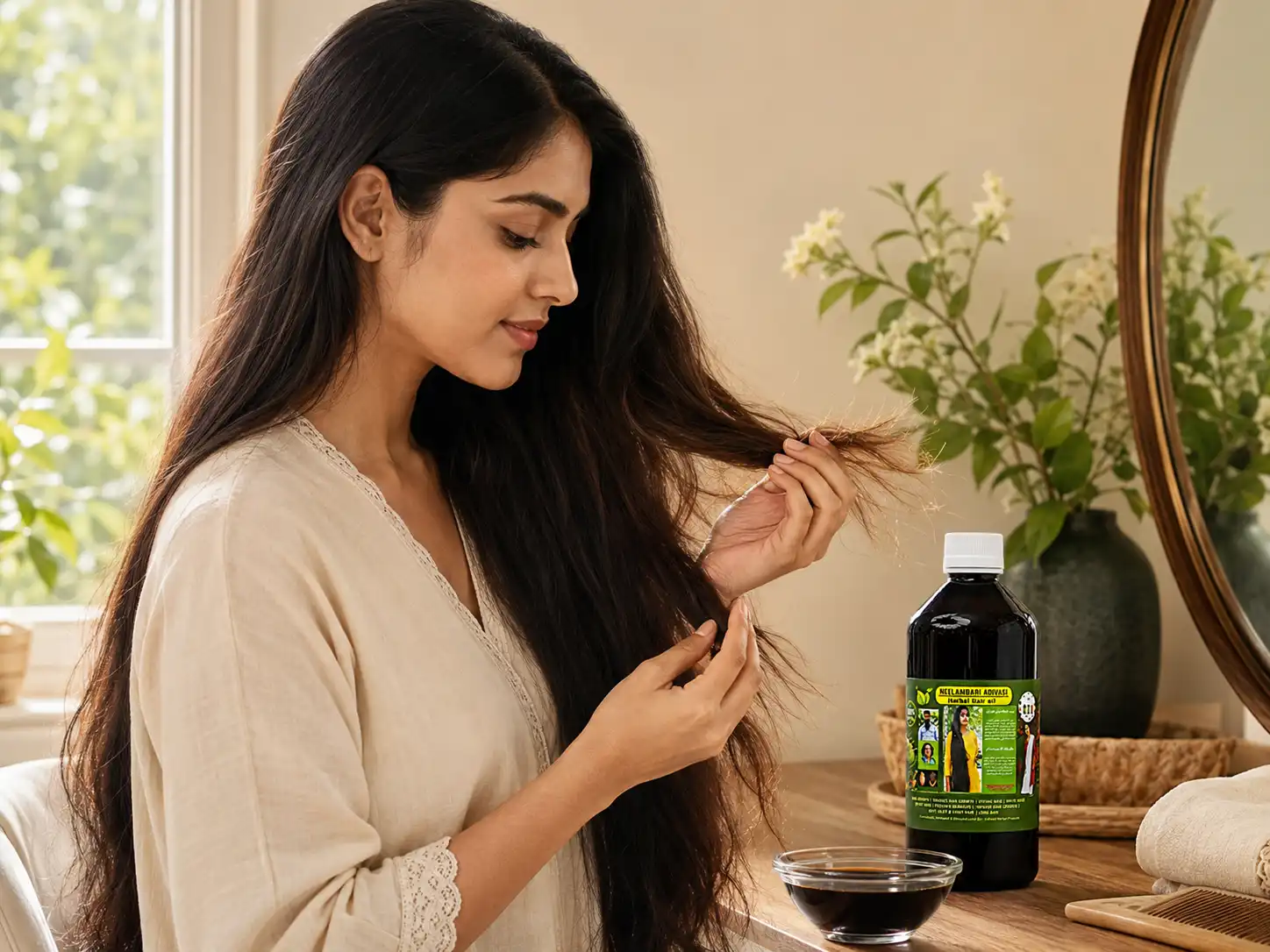
Split and tired ends are one of the most annoying hair problems for many, as they make the hair look less tidy, drier, and harder to style. Even if the hair at the roots is fine, dry or split ends may spoil the entire overall appearance.And here an important question arises:
Is tribal hair oil suitable for split and tired ends?And the short answer is: Tribal hair oil may help improve the appearance of dry and tired ends, soothe frizz, and make hair easier to style, but it does not definitively cure true split ends if the hair is already split. Therefore, it is better to use it as part of a balanced care routine, cutting the affected ends when needed, minimizing the causes of dryness and brittleness.
What is meant by split ends?
Split ends mean that the end of the hair has become split, weak, or chipped. And most often it appears at the bottom of the hair, especially if the hair:
Too long
Java
Painted
Too much heat exposure
Combing wildly
Exposed to too much friction
Not getting enough attention to the ends
How split ends appear?
You may notice:
Rough ends
Branched ends
frizz at the bottom of the hair
Faster entanglement
Difficulty in styling
An untidy appearance even after washing
And here the hair needs a routine that focuses specifically on the ends, and not just on the roots or scalp.
Does tribal hair oil cure split ends permanently?
It is important that the expectations are realistic.
If the hair is already split and split at the end, then there is no oil that can permanently “glue” the split ends or return the hair exactly as it was.
What can oil do?
Tribal hair oil may help with:
Improve the appearance of the ends
Reduce the appearance of dryness
Calming the frizz
Make the ends softer
Reduce tangles
Facilitate styling
Make hair look calmer and more tidy
And what not to expect?
It should not be expected that the oil alone completely eliminates true brittleness if the ends are very damaged. In some cases, cutting a small part of the ends is the best solution, and then using oil to preserve the appearance and comfort afterwards.
When tribal hair oil is useful for the ends?
It may be useful if the ends:
Dry
Rough
Many hishans
Tired of the heat
Affected by pigmentation
Fast interlocking
You need softness and calm down
In these cases, tribal hair oil can be used as an intensive care step on the ends, provided that the amount is appropriate and the oil is not applied to the entire hair unnecessarily.
How best to use tribal hair oil for Split ends
The best way is to make the oil directed only to the ends or to the middle of the hair downwards.
The proposed method:
Take a light amount of oil
Distribute it between the hands
Pass it over the ends gently
Focus on dry and tired areas
Avoid roots if the scalp is oily
Leave it for a suitable period before washing or use a very small amount after washing, depending on the type of hair
Why only the ends?
Because Split ends and dryness often appear at the ends, while the roots may not need oil, and they may become heavy if oil is applied to them for no reason.
Is it better to use it before washing or after it for the ends?
Depends on your hair type.
Before washing
This method is suitable for most people, especially if the hair:
Light
Fatty from the roots
Fast and heavy
Does not tolerate oils after washing
In this method, the oil is applied to the ends for a suitable period and then gently wash the hair.
After washing
It may suit some types of dry, thick or curly hair, but the quantity should be:
Very few
On the periphery only
Without getting close to the roots
The best rule
If you are unsure, start before washing, as it is an easier way to control and reduces the likelihood of heaviness.
How often tribal hair oil is used for Split ends?
There is no fixed number that suits everyone, but it can be started this way:
For dry hair:
Once to twice a week before washing.
For light hair:
Once a week or less, and in a very small amount.
For oily hair from the roots:
Once a week only on the ends before washing.
For thick or curly hair:
Once to twice a week, with the possibility of a light touch after washing if the hair tolerates.The most important is to monitor the result: if the ends become calmer without heaviness, then a routine is suitable. And if heaviness appears, reduce the amount or number of times.
Can it be used daily on Split ends?
Some may think that split ends need daily oil, but this is not always necessary.
It may be suitable for light daily use if:
The hair was very dry
The ends are very rough
Hair is thick or curly
The quantity is too little
And no heaviness appears
It often does not fit if:
Hair is light
Greasy hair
ends stick out quickly
Hair easily loses its volume
The best
Start with regular use once or twice a week, then add a light touch on the tips only when needed, and not on an automatic daily basis.
Does tribal Hair Oil prevent increased brittleness?
A balanced care routine may help reduce the appearance of dryness and brittleness, making ends less prone to tangling and friction. But to reduce brittleness also needs to adjust daily habits.
To preserve the ends:
Reduce heat usage
Do not comb the hair violently
Use a suitable comb
Gently dry the hair
Avoid pulling hair too hard
Cut the affected ends when needed
Use oil in the right amount on the ends
Oil is an auxiliary step, but it is not alone in all the routine.
Does it fit split ends due to heat?
Yes, it may be suitable for improving the appearance of tired ends from a brush or iron, especially if the ends:
Dry
Many hishans
Difficult styling
Losing smoothness
But you should not use oil as a substitute for thermal protection. If you are using a razor or iron, it is best to use a suitable thermal protection product and reduce heat as much as possible.
The role of oil here
Its role is then to soothe the ends and make them softer and easier to style.
Does it fit split ends due to pigmentation?
It may suit dyed hair if used with caution, as the dye may make the ends drier.
The appropriate way:
Using oil after dyeing as a separate step
Focus on the ends
Not to put it on the roots
Use a light amount
Observe the color and texture
If the hair is freshly dyed or the color is sensitive, it is best to test a small amount on a small part of the ends first.
Is it suitable for light hair with Split ends?
Yes, but very carefully.Light hair may have dry ends, but their roots do not tolerate oil. Therefore, the best way is:
Very little quantity
On the periphery only
Before washing often
Once a week for a start
Avoid roots completely
If the hair has become flat or has lost volume, it means that the quantity or timing needs to be adjusted.
Is it suitable for thick or curly hair with tired ends?
Yes, it may be very appropriate as part of a limb care routine.
The appropriate way:
Apply oil to dry ends and strands
Use a balanced amount
Before washing once to twice a week
Or a light touch after washing if the hair tolerates
Avoid overdoing so that the strands do not lose their mobility
The sign of success
That the ends become calmer, the tangles are less tangled, the strands are more tidy without pronounced heaviness.
When do the ends need to be cut instead of just oil?
If the ends are:
Clearly branched
It breaks easily
Very coarse, no matter how much oil is used
Constantly intertwined
Always give an untidy look
It may be better to cut a small part of the affected limb than to try to cover the problem only with oil.
After mowing
Tribal hair oil can be used to preserve New ends, make them quieter and easier to style.
Common mistakes when using oil for Split ends
1. Using oil instead of cutting very damaged ends
The oil improves the appearance, but does not completely restore split hair.
2. Applying oil to the roots
Although the problem is in the ends.
3. Use a large amount
It may weigh down the hair and hide the real result.
4. Use oil daily without need
May cause build-up especially of light hair.
5. Ignoring the cause of Split ends
Such as heat, dye, rough combing, or friction.
Where does the role of Adivasi Herbal come from here?
Split and tired ends need calm and orderly care, here it can be Tribal hair oil from Adivasi herbal A suitable step within a routine that focuses on dry ends, reducing the appearance of brittleness and improving the ease of styling.The idea is not to use a large amount, but a smart and limb-oriented use, while minimizing the factors that increase dryness and brittleness.
Conclusion
Tribal hair oil may be suitable for split and tired ends because it helps to improve the appearance of dryness and brittleness and make hair easier to style, but it does not cure real split ends definitively if the hair is already split. It is best to use it only on the ends, in the right amount, and within a balanced routine that includes reducing heat, gentle styling, and cutting the affected ends when needed.
Frequently asked questions (FAQ)
Does tribal hair oil cure split ends?
It may help improve the appearance of dry and tired ends, but it does not completely cure true split ends if the hair is already split.
Do I apply tribal Hair Oil only on the ends?
Yes, if the problem is in brittleness or dryness, it is better to focus on the tips and avoid the roots.
How often do I use it for Split ends?
Start once a week for light or oily hair, and one to two times a week for dry or thick hair.
Can it be used after washing?
It can be in a very small amount only on the ends, especially for dry or thick hair, but if it causes heaviness, it is better to use it before washing.
Does the oil sing about cutting the ends?
No, if the ends are very split, you may need a simple cut, and then use oil to maintain the appearance of the ends.
Is it suitable for dyed or heat-damaged hair?
It may suit him if used on the ends and in the right amount, with heat reduction and gentle care.
Conclusion
Split ends need a realistic understanding: it is not enough to apply oil only if the split is very pronounced, and habits that weaken the ends Daily should not be ignored. But the use of Tribal hair oil In the right way it can help to make the ends quieter, softer in texture, easier to style.
Focus on the ends, start with a small amount, and watch the result, because Smart Care is not in the abundance of products, but in using them at the right place and time.