
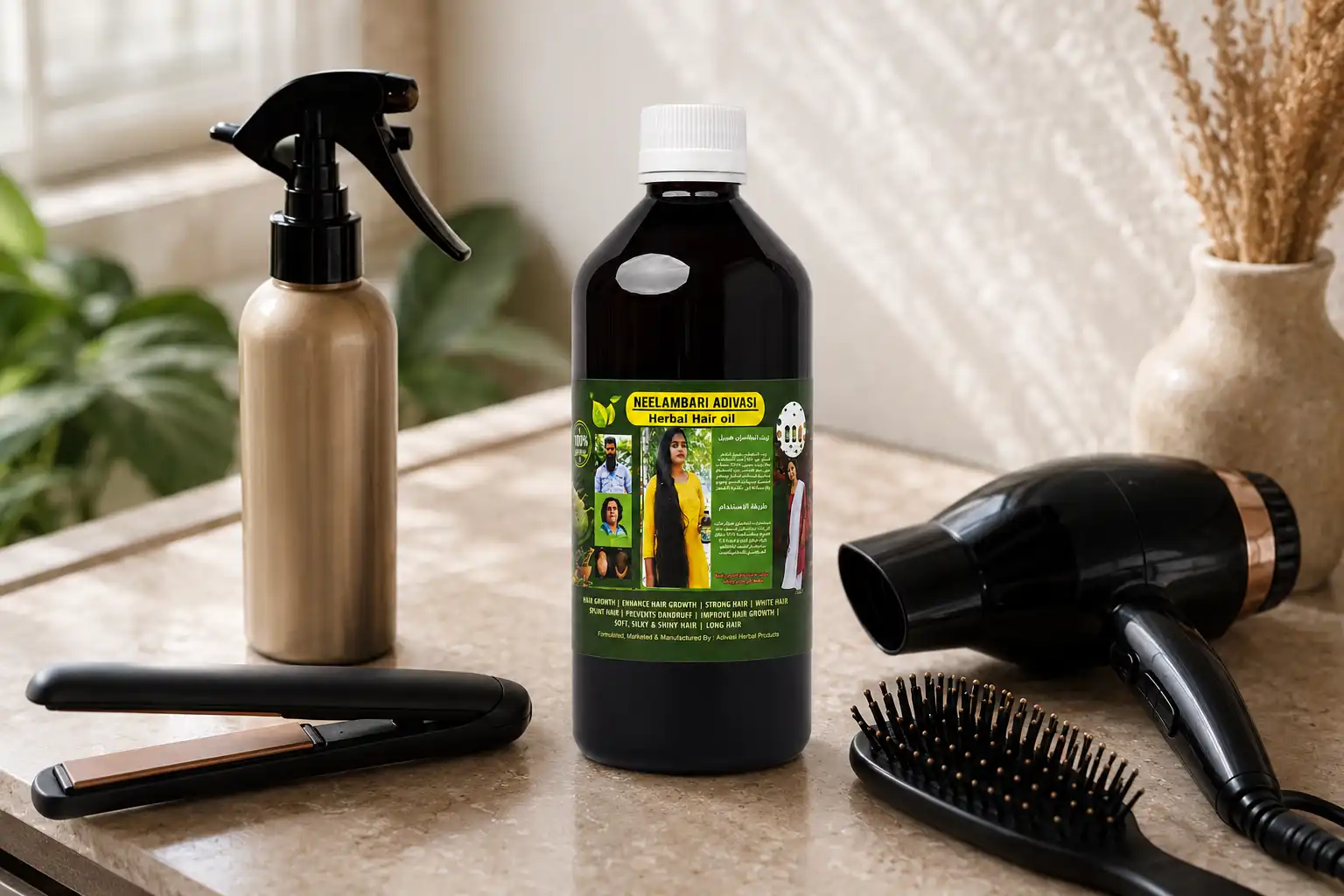
Many people use thermal styling tools such as a brush, irons or straighteners and curlers, and at the same time they want to keep hair smooth, reduce dryness and brittleness. And that's why a very important question is repeated: Can tribal hair oil be used with heat protector?
And the short answer is: Yes, tribal hair oil can be used with a heat protector, but on condition that each step has a clear role and the care does not turn into heavy layering on the hair. A heatsink has a different function than an oil one،
When they are properly coordinated, they can benefit from supporting shape and softness on the one hand, and reduce the impact of dehydration and fatigue on the ends on the other.
What is the difference between tribal hair oil and heat protector?
To understand the method of coordination between them, it is important to know that Oil and heat protector are not the same thing.Tribal hair oil is often used for:
Calm the ends
Reduce the sensation of dryness
Softness support
Reduce the appearance of brittleness
Enter it into a routine before or after washing with a light amount
As for the heat protector, it is usually used for:
Preparing hair before a brush or styling tools
Reduce heat-induced stress
Support styling in a nicer way
Reduce the chances of pronounced dryness of hair after styling
Help the hair to withstand the thermal routine more evenly
Therefore, the oil is in many cases Step carefully and calm down, While the heat protector is Preparation and protection step before thermal styling.
Can tribal hair oil be used with a heat protector really?
In many cases, yes.
Especially if the hair:
Dry at the ends
Fast frizz
Exposed to heat or heat frequently
Long or medium length
Curly or wavy
Tired of styling
He needs a routine that maintains appearance and comfort at the same time
In these cases, a heat protector may be an important step before styling, while tribal hair oil comes as a supportive step so that the ends do not look dry or tired.
When is the combination of tribal hair oil and heat protector useful?
This combination may be more useful when your goal is:
Reduce heat-induced dehydration
Calm the ends
Support hair smoothness
Reduce the appearance of brittleness after sheshwar
Keeping hair looking tidy
Build a routine that combines protection and care
Reduce the sensation of hair roughness after styling
And here the success is in Two-step format- Do not use a large amount of each product.
Is the heat protector singing about tribal hair oil?
Not always.
Heat sinks may be excellent in:
Preparing hair for styling
Reducing the apparent effect of heat
Support the shape during brushing or straightening
But they are not always enough if the hair suffers from:
Pronounced dryness
Tired ends
Roughness in texture
frizz linked to dryness
Loss of smoothness
And here tribal hair oil may well be a complementary step to care, and not a substitute for a heat protector.
Does tribal hair oil sing about the heat protector?
In many cases, too, no.
Because the oil may help soothe the hair and make it softer, but it often does not perform the same function as a heat protector, especially if the goal is:
Hair preparation before the haircut
Support thermal styling routine
Reduce heat stress
Protect hair during direct exposure to hot tools
Therefore, it is better not to look at the oil and the heat protector as if one cancels the other, but as if they They may serve two different goals within the same routine.
What is the best way to use tribal hair oil with a heat protector?
There is more than one practical and convenient way:
1. Use tribal hair oil before washing, then heat protector before styling
And this is one of the most balanced ways.
The oil is a pre-care step within the weekly routine, while the heat protector comes after washing and before the shower or any thermal tool.
2. Use the heat protector first on wet or semi-dry hair, then a very light touch of tribal hair oil on the ends after finishing styling
This method may suit some people if the ends need additional cooling, but the amount of oil should be Very light So that the hair does not look overloaded.
3. Use a heat protector on styling days, and oil on grooming days
Some people prefer to separate the two steps:
Heat protectors when using a razor or iron
And oil on the day of care or before washing
This is one of the smartest ways, especially for light hair or for hair that gets heavy quickly.
Do I use oil and heat protector at the same moment?
In most cases، It is better not to put a clear amount of oil and then rely on it directly under the heat.
If the combination is in the same routine, then preferably:
The heat protector is the basic step before styling
And tribal hair oil either before washing on another day, or a very light touch to the ends after finishing styling
But many people get a better result when the oil is in A different time About the time of thermal protection, this often makes the routine lighter and clearer.
Is this format suitable for all hair types?
It may suit many types, but the method of use varies depending on the type of hair.
Dry hair;
This is one of the types that may benefit the most from the combination of tribal hair oil and heat protector, because dry hair may need to reduce the styling effect while maintaining the comfort of the ends.
Oily hair
It can suit him, but in a lighter way:
Convenient and light heat protector
And oil in a very small amount
And often far from the roots
Or make the oil before washing instead of after
Light hair
It needs high accuracy:
Light heat protector
And oil with a very small touch only on the tips
And not to use the two products heavily at the same time
Curly or thick hair
Often it may clearly benefit, because this type of hair may need protection during styling with additional support to reduce dryness and brittleness.
Is it better to use heat protector first or tribal hair oil first?
If it's about the same day of styling, then most often it's Heat protector first Because it is the step intended for preparation before exposure to heat.
As for tribal hair oil, if used in the same routine, it is often:
Before washing on the day of care
Or after styling with a very light touch on the ends
But in general, it is easier and clearer to have:
Pre-heat heat protector
And oil for care before washing or for ends after styling
Is it suitable for curly or wavy hair?
Yes, and this may be one of the cases that most benefit from this format.
Curly or wavy hair often needs:
Protection when styling with heat
Reduce fragility
Calm the ends
Softness support
Here, a heat protector may help prepare the hair for styling, while tribal hair oil supports the ends and relieves the feeling of roughness or dryness.
Is it suitable for dyed or treated hair?
Yes, and this routine may be more important here.
Dyed or treated hair is often:
More sensitive to heat
More prone to dehydration
Faster to show roughness or fatigue
Here, a heat protector may help reduce the styling effect, while tribal hair oil adds a supportive step to the ends or to the overall softness if used intelligently.
What are the common mistakes when using oil with a heat protector?
There are errors that make the result less comfortable, such as:
1. Use a large amount of both
And this is the most common mistake.
Even if the hair is dry, overdoing it can make the hair heavier and less pliable to style.
2. Putting the oil before the heat is clearly a plus
Especially if the hair is thin, oily or if the amount is large.
3. Ignoring the ends
The ends are the part that most needs support after thermal styling.
4. Use heat a lot with the expectation that the oil will make up for everything
The oil supports the care, but does not eliminate the effect of frequent heat if the whole routine is exhausting.
5. Non-observance of the type of hair
What suits thick, dry hair does not suit light or oily hair in the same way.
How do you know that this format is suitable for your hair?
You can notice this by some signs:
Did the hair remain softer after styling?
Have the ends become calmer?
Has the dryness eased?
Do you say the frizz?
Did the hair look comfortable and not burdened?
Is the routine itself easy and clear?
If these indicators are positive, then most likely the use of tribal hair oil in combination with a heat protector is suitable for you in this way.
How to build a simple routine that includes tribal hair oil and heat protector?
The practical routine can be as follows:
Use tribal hair oil before washing once or twice a week as needed
Use a heat protector before brushing or styling tools
Apply a very light touch of oil to the ends only after completion if they need additional cooling
Not to overdo the quantity
Reduce heat as much as possible
Monitor the hair response and quietly adjust the routine
And here some people prefer calm herbal routines that give hair balanced care, such as Adivasi Herbal, Especially when wanting to build a work routine that supports softness and reduces dryness and brittleness without complication.
When is it not necessary to combine them?
Such a merger may not be necessary if:
Hair is already balanced
The heat protector alone is enough
Oil alone is used only on caring days
Hair quickly thickens
The scalp is oily and the hair is very light
Or if you notice that the two steps together don't add up to a real difference
In this case, the best is Simplifying the routine Allowance for increasing steps.
Common mistakes
1. The belief that tribal hair oil and heat protector should always be used together
The fact is that some hair needs them together, and some of them are enough for one as needed.
2. Use a large amount of both
This may make the hair heavier than necessary, especially if it is light or greasy.
3. Put the oil before the heat very clearly
Especially if the goal is lightness or if the hair is impressionable.
4. Ignoring the type of hair
Dry hair is different from oily, and light is different from thick or curly.
5. The complexity of the routine
The clearer the role of each step, the better and more comfortable the result will be.
Conclusion
Yes, tribal hair oil can be used with heat protector, And this format may be very useful for some types of hair, especially if the hair is dry, brittle or subjected to frequent thermal styling. But success here depends on having every step Clear role, light quantity and convenient timing. Therefore, the best is always Smart and simple formatting It makes the hair softer and more comfortable while reducing the styling effect, without heaviness and complexity.
Frequently asked questions (FAQ)
Can tribal hair oil be used with heat protector?
Yes, for many people it is possible if the use is balanced and each step has a clear goal.
Is the heat protector singing about tribal hair oil?
Not always, because heat protectors often focus on preparation before styling, while oil may be a more obvious care step for ends and dryness.
Does tribal hair oil sing about the heat protector?
In many cases not, because a heat protector may be more suitable for pre-processing hair before a brush or styling tools.
What is the best way to combine them?
Often heat protector before styling, tribal hair oil before washing or on the ends in a very light amount after styling when needed.
Does it suit oily hair?
It can suit him, but in a lighter way and often away from the roots.
Is it suitable for curly hair?
Yes, and often it can be very useful because it helps to reduce the effect of heat while calming dryness and brittleness.
Conclusion
Hair care depends not on the abundance of products, but on Understand the role of each step within the routine. When it is coordinated Tribal hair oil With Heat protector In a calm and balanced way, the hair may become softer, calmer and easier to style without heaviness or complexity.
And in the end, the best routine is not the one that contains the most steps, but rather Which gives your hair the best result in the simplest possible way.