
Introduction
Many people fall asleep immediately after bathing without waiting for the hair to dry, especially when tired or short of time.
But the important question is: Does sleeping with wet hair really hurt the hair?
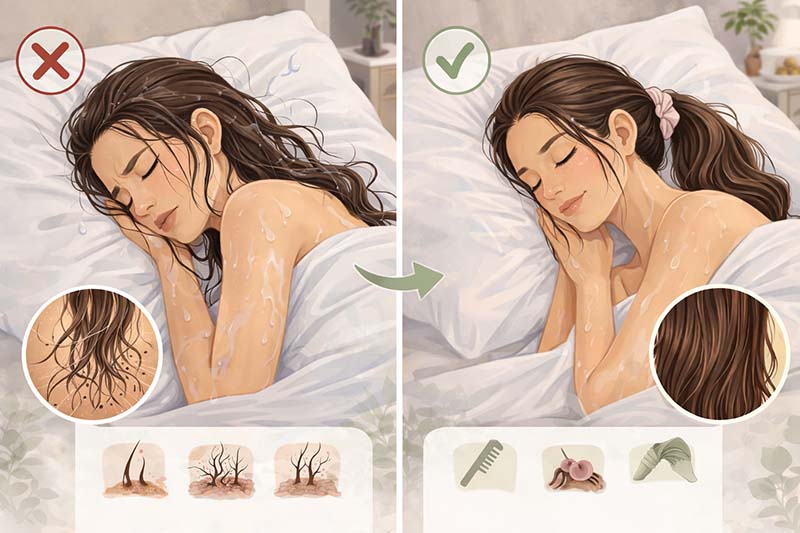
The fact is that when the hair is wet it is More vulnerable and sensitive, And with constant friction with the pillow during sleep, this may increase the chances of Breakage, entanglement, brittleness, and brittleness.
And not only that, some people may also feel discomfort on the scalp if they get used to sleeping with wet hair frequently.In this article we will show you simply the truth, when this habit is harmful, and how to protect your hair if you have to sleep after washing your hair.
First: does sleeping and wet hair hurt the hair?
Yes، May harm the hair If it is repeated continuously, because wet hair during sleep is at its weakest.
Why?
Because when the hair is wet it is:
- More tensionable
- Weaker than its dry state
- Faster to tangle
- More prone to breakage with friction
- Easier to lose its natural shape
What happens during sleep?
While flipping over the pillow, wet hair is exposed to:
- Frequent friction
- Squeeze the strands
- Entanglement between the bristles
- Indirect tightening on the ends and roots
This may make the hair look weaker and more frizzy in the morning.
Secondly: what are the possible harms of sleeping with wet hair?
Not all damage appears immediately, but with repetition you may begin to notice a clear difference in the health of the hair.
Possible damage:
- Hair breakage
- Clear frizz
- Tangle in the morning
- Pounding in the ends
- Loss of hair smoothness
- Difficulty styling after waking up
And in some cases:
The scalp may feel uncomfortable if it stays wet for a long time, especially if it is sensitive or prone to problems.
Third: when is sleeping with wet hair more harmful?
Some cases are more sensitive than others.
The damage is greater if:
- The hair was too long
- The hair was originally split
- The hair was dry or dyed
- You were sleeping on a pillow that causes strong friction
- The hair was tied up and it was wet
- This habit was constantly repeated
Signs that your hair is being damaged by this habit:
- Waking up with very tangled hair
- Increased breakage when combing
- Dryness or roughness more than usual
- Loss of gloss
- Crisp is visible even after styling
Are all hair types affected in the same way?
No, the type of hair makes a lot of difference.
Hair most susceptible to damage:
- Dry hair;
- Dyed hair
- Curly or wavy hair
- Weak hair
- Split hair
- Long hair;
Relatively less affected hair:
Short or strong hair may be less affected, but this does not mean that sleeping with it while wet is a habit that is always appropriate.💡
The weaker or drier the hair, the more likely it will be damaged during sleep while wet.
How to know that this habit does not suit your hair?
Ask yourself these questions:
- Do you wake up with your hair so tangled?
- Do you notice more cracking in the morning?
- Have the ends of your hair become weaker?
- Did your hair become fluffy after sleeping?
- Do you feel that the texture of your hair is worse immediately after washing and sleeping?
If the answer is yes
Sleeping with wet hair often affects your hair, and your routine needs to be adjusted.
Reasons that make the problem bigger
Sometimes the problem is not only in sleeping with wet hair, but in some accompanying habits.
Common causes:
- Sleep immediately after bathing
- Not drying hair gently
- Tying hair while wet
- Neglect of untangling before bedtime
- Use high heat and then leave the hair exhausted
- Lack of attention to dry ends
- Repeat the habit daily or sporadically
What is the best way if you wash your hair at night?
If you have to wash your hair at night, it is better to minimize the damage as much as possible.
The right way:
- Gently dry the hair with a towel without rubbing
- Let it air out as much as possible
- Untangling with a wide-toothed comb
- Don't sleep while it's too wet
- Avoid tying it too tightly
- Focus on calming hair before bed
Always the best:
To have hair Slightly wet or semi-dry Before bedtime, not completely wet.
Is it possible to sleep with hair slightly damp?
Yes, this Better than sleeping in it completely wet, But he also needs gentle handling.
When is the situation better?
- If the hair is semi-dry
- If it is not tightly tied
- If it is not entangled
- If the ends are in good condition
- If this habit is not daily
The difference is very important:
hair A little wet Less prone to damage than hair Very wet.
Adivasi routine to support hair and reduce breakage
If you wash your hair at night a lot, the ideal is to support the hair with a protein that reduces dryness and breakage.
Proper routine:
- Attention to the scalp if there is weakness or flaking
- Apply oil to the ends if there is dryness or brittleness
- Reduce tension and friction
- Avoid sleeping with hair completely wet
- Adhere to a consistent and gentle routine
If the problem is at the roots
Focus on the scalp and regular care.
If the problem is in the ends
Focus on hydration, reducing friction and tangling.
Common mistakes
- Sleep immediately after washing hair
- Leave hair completely wet overnight
- Tying hair while wet
- Combing hair wildly in the morning
- Ignoring split ends
- Repeat this habit continuously
- The belief that harm occurs only if the hair only falls out
Conclusion
Sleeping with wet hair It may actually harm the hair, Especially if it is repeated a lot or the hair is already dry, brittle or weak.
And with constant friction during sleep, the chances of Breakage, fragility, and entanglement Clearly.Therefore, it is better to give your hair time to dry as much as possible before bedtime, and handle it gently so as to preserve its strength and healthy texture.
Frequently asked questions (FAQ)
Does sleeping with wet hair cause hair loss?
It may not be the only direct cause, but it may weaken the hair and increase breakage and tangles, especially if the hair is already sensitive.
Is tying hair before bed while wet worse?
Yes, it is often worse because the hair is stretched and pressed with moisture remaining, and this may increase brittleness and breakage.
When do I see a difference if I stop this habit?
A difference in tangles, brittleness and breakage can often be noticed within weeks with adherence to a gentler routine after washing.
Conclusion
Some small habits before bedtime may affect hair health more than we expect, and sleeping with wet hair is one of the most common of them.
And when you give your hair a little time to dry, and gently treat it before bedtime, you will notice a clear difference in its softness and strength with time.
Order Adivasi herbal oil now: