
Introduction
Many people focus on the hair itself and forget that The scalp is the real foundation of hair health.
Over time, fat, product residues, sweat, and dust may accumulate on the scalp, and this may make it look Stressful, greasy, or uncomfortable Even if you wash your hair regularly.And here an important question arises: How do I know that my scalp needs a deep cleaning?
And most importantly: How to take care of her in a gentle and natural way, especially using herbs?
In this article we will show you the signs that the scalp needs deeper care, and how it can be supported by a balanced and gentle protein that helps restore a sense of cleanliness and comfort.
What is meant by deep scalp cleansing?
Deeply cleansing the scalp does not mean washing it violently or using harsh products, it means:
- Removing excess accumulations
- Relieve accumulated fat
- Cleaning of product residues
- Help the scalp breathe better
- Restore balance and comfort to the scalp
Deep cleaning does not mean cruelty
Some people think that deep cleansing means vigorous rubbing or very frequent washing, but the truth is that the scalp needs Smart and gentle cleaning, And not drying or irritating.
Signs that the scalp needs deep cleansing
1. Fat accumulates quickly
If you notice that your hair looks greasy quickly even shortly after washing, the scalp may be in need of deeper cleansing than usual.
2. Frequent itching of the scalp
Constant itching may be a sign that there are accumulations or discomfort in the scalp.
3. A feeling of heaviness in the roots
When you feel that the roots are heavy or the hair is not fresh even after washing, this is an important sign that the scalp may need additional care.
4. Crust or visible deposits
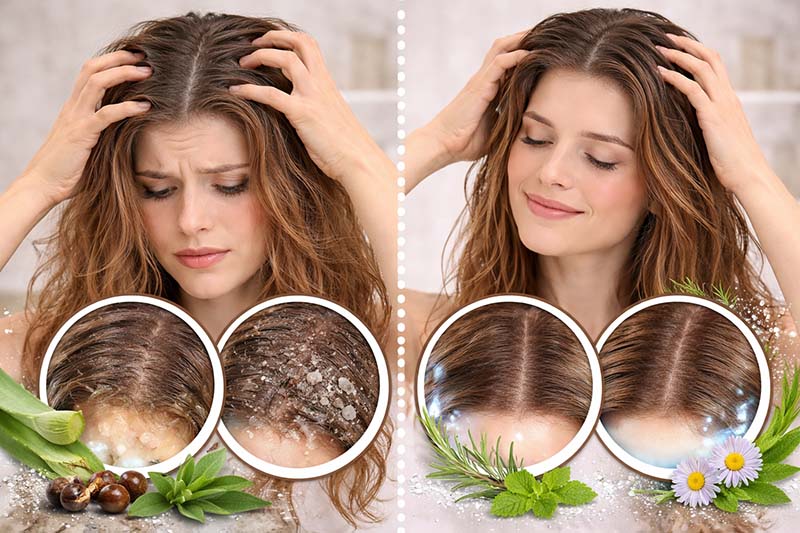
The appearance of dandruff, white residue or accumulations on the scalp may indicate that the usual cleaning is no longer enough.
5. Loss of sense of cleanliness after washing
If you have washed your hair but still feel that the scalp is not completely clean, this is a signal that should not be ignored.
6. Poor hair response to routine
Sometimes the problem is not in the product itself, but in the scalp, which has become overloaded with accumulations, the hair does not look as good as it was.
7. Unpleasant odor in the scalp
If an unpleasant odor appears quickly despite washing, the cause may be the accumulation of fat or products on the scalp.
8. Flattening of hair from the roots
Hair that quickly loses volume at the roots may be affected by the heaviness of the scalp and the accumulation of oils or residues.
9. Increased use of products without result
If you apply a lot of products to the hair but do not see a clear difference, the reason may be that the scalp already needs a balanced cleansing first.
10. A feeling of blockage or general fatigue of the scalp
Some people call the scalp "muffled" or uncomfortable, this is a common description When fat and care residues accumulate on it.
Why do impurities accumulate on the scalp?
There are several common reasons, including:
- Use oils or creams abundantly
- Not washing hair properly
- Using shampoo in an unbalanced way
- Sweat and dust
- Remnants of sprays or serums
- Washing hair quickly without cleaning the scalp well
- Not rinsing the products completely
How to take care of the scalp when you need a deep cleansing?
1. Focus on the scalp while washing
Instead of focusing only on the length of the hair, make the basic cleaning directed at the scalp.
2. Do not use nails wildly
Massage should be with gentle fingertips, and not with harsh rubbing, which may irritate the scalp.
3. Thoroughly wash the scalp from the remnants of products
Some people apply the product and then rinse quickly, so part of the build-up or foam remains on the scalp.
4. Soften too many products on the roots
If the scalp is overloaded, it is better not to load it with too many oils and creams at the same time.
5. Follow a regular routine, not random
The scalp often benefits more from a fixed routine than from too many and violent changes.
How to support the scalp with herbs?
Herbal Care is preferred by many people because it gives a gentler and more natural feeling within the routine, especially if the scalp needs calming and balanced cleaning.
The benefits of herbal care for the scalp may include:
- A sense of freshness
- Support scalp comfort
- Reducing the sensation of heaviness
- Making the routine gentler on the scalp
- Support balance instead of overdrying
💡 Important Herbal Care should be part of a balanced routine, not a substitute for proper hygiene or smart use of products.
Suggested scalp care routine in a balanced way
If you feel that your scalp needs deep cleansing, a simple routine can be followed such as:
The first step
Gently clean the scalp with an emphasis on the roots.
The second step
Massage the scalp with fingertips to activate the sensation of cleanliness and comfort.
The third step
Use appropriate Herbal Care as part of the routine if the scalp tends to heaviness or accumulations.
The fourth step
Loosen and put heavy products directly on the roots.
The fifth step
Pay attention to regular cleaning, do not overdo it with washing.
When is the problem not only of accumulations?
Sometimes a person feels that the scalp needs a deep cleaning, but the reason may be deeper than that if the symptoms persist very clearly.
For example, if there is:
- Very severe itching
- Chronic and annoying dandruff
- Persistent redness
- Pain in the scalp
- Noticeable shedding of roots
Here it is better not to rely only on changing the routine, but to pay more attention to the cause of the problem.
Common mistakes
- Washing the scalp too violently
- Using nails instead of fingertips
- Applying too much oil to the scalp frequently
- The belief that more shampoo means better hygiene
- Completely discard the rinsing of products
- The use of many products on the roots
- Confusing deep cleaning with harsh drying
Conclusion
The scalp may send clear signals when it needs deeper cleaning, such as:
- Rapid fat accumulation
- Itching
- Feeling of heaviness
- Crust or residue
- Loss of sense of cleanliness
And the correct handling of these signs is not cruelty, but a balanced protein that focuses on:
- Gentle cleaning
- Reduce accumulations
- Scalp comfort support
- And use proper Herbal Care within a thoughtful routine
When you take care of the scalp in the right way, this gradually reflects on the comfort of the hair and its appearance as well.
Frequently asked questions (FAQ)
Does every oily scalp need a deep cleansing?
Not always to the same degree, but if fat accumulates quickly with a feeling of heaviness or itching, then most often the scalp needs deeper and more balanced care.
Is Herbal Care alone enough?
They may be useful as part of a routine, but it is always better if they are with proper cleaning and reduce accumulations and wrong habits.
How often does the scalp need deep cleansing?
This depends on the nature of the scalp, the amount of products used, and how quickly fat or residue accumulates. The important thing is to balance, not overdo it.
Does cleaning the scalp deeply means washing the hair more often?
No, the goal is not frequent washing, but to improve the quality of cleaning and the method of scalp care.
Conclusion
If you notice that your scalp has become:
- Heavy
- Quickly greasy
- Or uncomfortable despite washing
This may be a signal that she needs Deeper cleansing, a gentler, more balanced routine.
And proper scalp care is not a secondary step, but an important basis in any hair care routine.
Order Adivasi herbal oil now: