
Introduction
Many people comb their hair immediately after washing while wet, because they believe that this is the easiest way to untangle.
But the important question is: Does combing hair while wet really harm it?
The fact is that when wet, the hair becomes Weaker and more flexible, Meaning that it may be more prone to pulling, cracking, and brittleness if handled the wrong way.
But this does not mean that combing wet hair is always forbidden, the difference is in Method, tool, type of hair.In this article we will show you when combing wet hair is harmful, when it is possible, and how to comb your hair the right way to reduce breakage and keep it healthy.
First: does combing hair while wet cause breakage?
Yes، May cause cracking If done incorrectly, because the hair while wet is more sensitive than when it is dry or semi-dry.
Why?
When the hair absorbs water, its elasticity changes and it becomes:
- Weaker when screwing
- More stretchable
- Faster to break if the Tangle is severe
- More prone to damage if you use improper force or tool
When does the damage increase?
- If the hair is very tangled
- If you use a stiff brush
- If combing starts from the top
- If the hair is pulled violently
- If the hair was originally dry, brittle or dyed
Secondly: when is combing wet hair more harmful?
Not all hair is affected to the same degree, but some cases are more sensitive.
Cases most prone to cracking:
- Dry hair;
- Dyed hair
- Split hair
- Curly or wavy hair
- Hair weakened by heat
- Long hair is very tangled
Signs that your hair is damaged from combing while wet:
- The appearance of broken short hairs
- Increased brittleness after styling
- Pronounced split ends
- Loss of hair smoothness
- Difficulty in deciphering the contract
- Notice a lot of hair on the brush after washing
Third: is it possible to comb the hair when it is wet sometimes?
Yes، Can In some cases, but provided that it is Gently and in the right way.
When is it possible?
- If the hair has a balm or a product on it that helps to slip
- If a wide-toothed comb is used
- If combing quietly and from the ends first
- If the goal is only untangling, and not tightening and strong styling
- If the hair is curly and needs a gentle loosening during moisturizing
The difference here is important:
The problem is not only in the presence of water, but in How to deal with wet hair.
How do you know that your hair needs a gentler way after washing?
Ask yourself these questions:
- Does your hair get tangled quickly after a shower?
- Do you notice more broken hair than usual?
- Does the hair become fluffy after combing?
- Do the ends of the hair look weaker after each wash?
The simple rule:
- If your hair breaks easily: Don't comb it violently while it's wet
- If your hair is curly or tangled: Loosen it very gently and with the right tool
- If your hair is weak or dyed: Give him time and start with him more calmly
💡 Many people think that strong combing resolves tangles faster, but in fact it may increase the problem.
Causes of hair breakage after washing
Sometimes a person thinks that the cause of breakage is the product, while the real reason is in everyday habits after a shower.
Common causes:
- Violent combing
- Using an unsuitable brush
- Rubbing hair with a towel
- Pulling hair while wet
- Use heat immediately after washing
- Neglect of balm or moisturizing
- Let the knots pile up and then try to untie them all at once
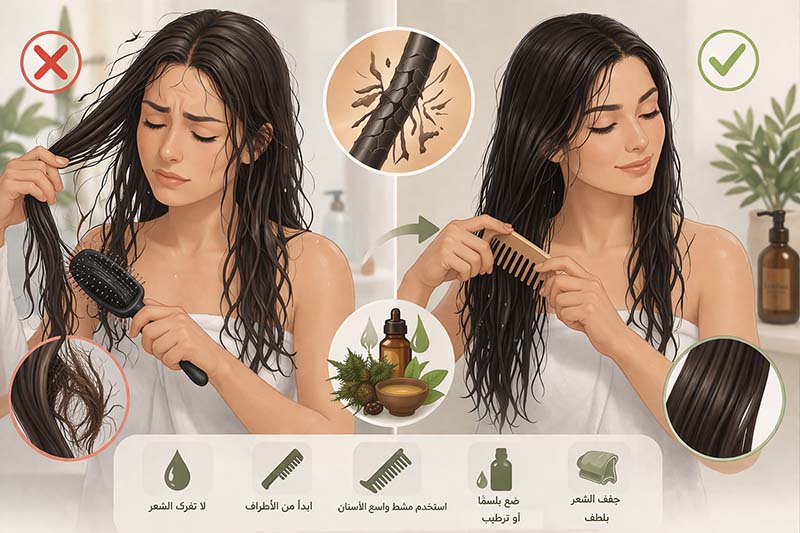
What is the correct way to comb hair after washing?
The right way:
- Gently dry the hair without rubbing
- Let it cool down a little if it's too wet
- Use a wide-toothed comb
- Start from the ends
- Gradually climb to the top
- Untangling on small parts
- Do not tighten the hair strongly
Very important:
If the hair is very tangled, do not try to untangle it quickly.
The quieter the loosening of the knots, the safer the hair and the less likely it is to break.
Is it better to comb hair while wet or dry?
The answer depends on Type of hair:
Straight or fine hair
It's often best to let it dry a little and then comb it gently, especially if it breaks quickly.
Curly or wavy hair
In many cases, untangling while in the presence of a moisturizer or balm is easier and better than combing it dry, but provided that it is done very gently.
Dry or dyed hair
It is better to handle it with great care, and not to tighten it while it is wet, since this type is more sensitive to damage.
Adivasi routine to support hair and reduce breakage
If your hair breaks after washing, care does not stop only at combing, but starts from the whole routine.
Proper routine:
- Attention to the scalp if there is a general weakness
- Apply oil to the ends if there is dryness or brittleness
- Reduce heat
- Use gentle combing
- Maintain a consistent care routine
If the problem is an obvious fracture:
Focus more on the tips, moisturizing, and reducing tightness.
If the problem is a weakening of the roots with cracking:
Also take care of the scalp with a balanced full hair routine.
Common mistakes
- Combing hair directly from the roots
- Using a stiff brush on wet hair
- Tighten the knots firmly
- Rubbing hair with a towel
- Ignoring split ends
- Use heat immediately after untangling
- The belief that all hair types are treated the same way
Conclusion
Combing hair while wet May cause cracking If it is done violently or with an unsuitable tool, because the hair in this case is more vulnerable and sensitive.
But if the Tangle is untangled gently, with the right tool, and in a gradual manner, the damage can be significantly reduced.The most important thing is to understand Your hair typeAnd to deal with it after washing calmly, because many cracking problems start from this simple step.
Frequently asked questions (FAQ)
Is combing wet hair more dangerous than combing it dry?
In many cases yes, because wet hair is weaker and more prone to pulling and breaking if handled violently.
Is the brush suitable for wet hair?
It is often preferable to use a wide-toothed comb or a suitable gentle tool, as some brushes may tighten the hair too much.
When Will I see a result if I change the combing method?
Often, a difference in the amount of breakage and texture of the hair can be noticed within weeks with adherence to a gentler method and an appropriate care routine.
Conclusion
The method of combing hair after washing may seem like a simple step, but it makes a lot of difference in the long-term health of the hair.
And when you handle wet hair gently, and use the appropriate method for your hair type, the chances of breakage, brittleness and split ends are clearly reduced over time.Order Adivasi herbal oil now: