
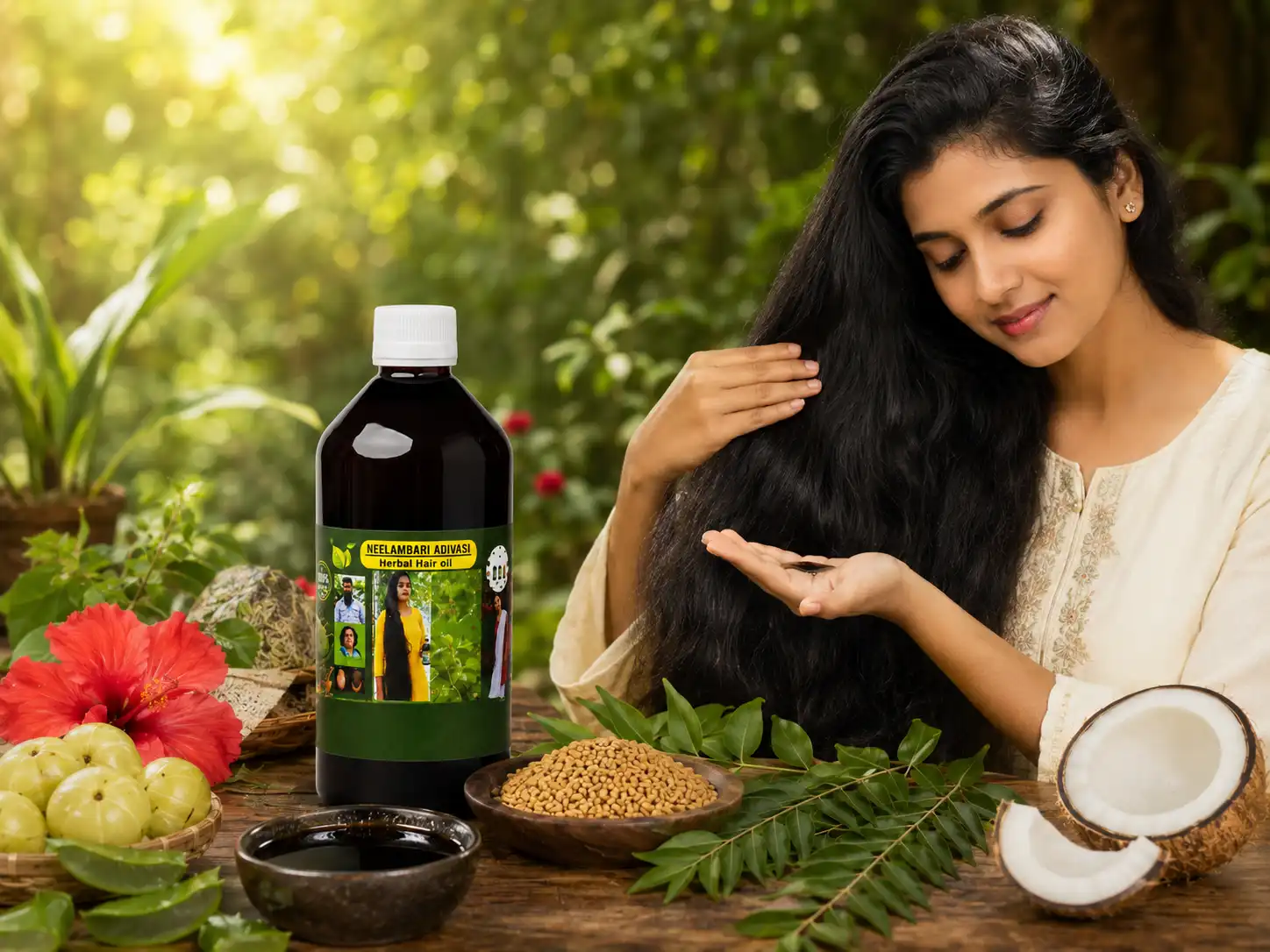
Become Indian Adivasi oil One of the most sought-after hair oils by those interested in natural hair care, especially those who suffer from hair loss, poor density, dry ends, brittle, slow hair growth, or difficulty styling.
It is also known as Adivasi herbal tribal hair oil, An herbal oil inspired by Indian hair care traditions.Many women are looking for an oil that will help hair look healthier, smoother, shinier and denser in appearance, but it is important to understand the role of Adivasi oil in a realistic way.
It is not a panacea that treats all hair problems from the first use, but it can be a supportive step within a regular care routine that helps the hair to look better with continuation and correct use.In this article we will learn about the benefits of Indian Adivasi oil for hair, the most prominent herbal ingredients, how to use it, and is it suitable for shedding, lengthening, blanks, dry hair, oily hair, and dyed hair.
What is Indian Adivasi oil?
Indian Adivasi oil is an herbal oil intended for hair and scalp care, based on the idea of mixing herbs and natural oils used in the traditional Indian hair routine. Adivasi herbal oil is known for its rich herbal composition, and is often marketed as an oil containing 108 herbs For hair care.
The basic idea of Adivasi oil is not only to moisturize the hair, but to support the complete care routine, by improving the appearance of the hair, soothing dryness, reducing brittleness, facilitating styling, and taking care of tired ends.
When used correctly, it may be suitable for those looking for a natural hair oil that is included in a weekly care routine, especially if the hair suffers from dryness, breakage, poor appearance, or difficulty styling.
Why are people looking for Indian Adivasi oil?
Interest in Indian Adivasi oil has increased because many people are looking for natural or herbal solutions to common hair problems. The most commonly searched for by users is: does Adivasi oil help reduce flaking Does it help with hair lengthening Does it fit the blanks What are its components Is it original And how to use it correctlyThis kind of search intention is very important, because a person is not just looking for a product, but is looking for a clear answer before buying:does this oil fit my problem Are the results realistic And what is the right way so as not to cause heaviness or greasy appearanceTherefore, the best way to understand Adivasi oil is to treat it as a supportive care oil, and not as a direct medical treatment for all hair problems.
The benefits of Indian Adivasi oil for hair
Supports the appearance of healthy hair
One of the most notable benefits of Indian Adivasi oil is that it may help hair look healthier and more vibrant, especially when the hair is dry, dull or tired from heat, dyes and frequent washing.When using the oil on the ends and the middle of the hair before washing, it may help improve the texture of the hair and make it calmer and easier to style.
This gives the hair a more tidy and shiny appearance, especially while continuing a regular routine.
Helps reduce the appearance of dryness
Dry hair is one of the most common problems that makes hair look coarse, Haiesha, and brittle. And Indian Adivasi oil may be suitable for dry hair because it helps to smooth the appearance of roughness and improve the texture of the ends.The best use here is before washing, focusing on dry ends and strands. The ends are often the part that needs the most care, especially in long, dyed or heat-damaged hair.
But you should pay attention that dry hair does not always need a large amount of oil. The right amount and good distribution are better than exaggeration, which may cause heaviness or build-up.
May help reduce brittleness
Fragility often appears due to dryness, moisture, heat, or poor care of the ends. And Adivasi oil may help reduce the appearance of frizz by making the strands calmer and more streamlined.
If your hair is frizzy after washing or becomes fluffy quickly, you can use Adivasi oil before washing once or twice a week depending on the type of hair. Over time, you may notice that the hair has become easier to style and less frizzy.But if your hair is light or soft, it is better to use a very small amount so that the hair does not lose its natural volume.
Supports the care of brittle hair
Adivasi oil does not permanently fix severe split ends, because a split limb often needs a simple cut if the damage is obvious. But it may help improve the appearance of tired ends and reduce the appearance of roughness and dryness.
Therefore, if your hair has tired ends, use oil on the ends regularly before washing, reducing the heat, avoiding violent combing, and using a suitable balm when needed.In this way the oil becomes part of a routine that maintains the ends and reduces the return of dryness and breakage.
Helps with the hair extension routine indirectly
Many people are looking for Adivasi oil for hair extension. And here an important point should be clarified: hair oil does not change the natural hair growth rate in a guaranteed or immediate way, but it may indirectly support the lengthening journey.How does it happen When the hair is dry and brittle, it may grow from the roots but the ends are constantly breaking, it looks like it does not lengthen.
Using Adivasi oil to care for the ends may help reduce the appearance of breakage and dryness, which helps the hair to retain length better over time.Therefore, it can be considered a supporting step in the lengthening routine, and not a quick promise of instant length.
Supports the appearance of density for light hair
Light hair needs smart care, because any excess weight or oil can make it look less voluminous. Adivasi oil may help improve the appearance of light hair if it suffers from dryness, breakage or frizz, but it should be used in a very small amount.
When reducing breakage and improving hair texture, hair may look more tidy and Fuller in appearance. But if there are pronounced voids, hereditary baldness or severe shedding, you should not rely on the oil alone, but find out the real reason.
May help facilitate styling and reduce tangles
Dry, long or curly hair can easily get tangled, and with violent combing, breakage or loss occurs due to pulling. Adivasi oil may help make hair softer and easier to comb, especially when used before washing.
This benefits long, thick, curly and wavy hair, as these types often need extra care for the ends and inner strands.
The main ingredients of Indian Adivasi oil
Adivasi oil is known as a rich herbal oil, often referred to as a composition containing a large number of herbs. The exact list of ingredients may vary by package or supplier, so it's always best to check the ingredients written on the original packaging.
However, Indian herbal oils are often associated with well-known ingredients in hair care such as Amla, bringraj, Brahmi, fenugreek, neem, hibiscus, aloe vera, coconut oil, sesame oil, and castor oil.
Hope
Amla is one of the most famous Indian ingredients in the hair routine. Traditionally used to care for dull and tired hair, they are often associated with improving the appearance of shine and vitality.The presence of amla in hair oils makes it suitable for those looking for a routine that supports the appearance of healthy and tidy hair.
Pringraj
Bringraj is one of the well-known herbs of Indian heritage for hair care. It is often associated with proteins of weakened or tired hair, and is used in formulations aimed at supporting the appearance of hair and improving the sense of density and strength.
Brahmi
Brahmi is a popular herb in Indian hair products. It is often used in formulations that care for the scalp and weakened hair.But like any herbal ingredient, it may not suit all sensitive furs, so the oil should be tried with caution if your scalp reacts quickly to the products.
The arena
Fenugreek is one of the well-known ingredients in hair care recipes. It is often associated with proteins of dry and tired hair, and may help in the composition to improve the texture of the hair and reduce the appearance of roughness.
Neem
Neem is a well-known plant in India, and is included in some hair and scalp care products. Its presence in herbal formulations is often associated with the care of the scalp and the general appearance of the hair.If the scalp is sensitive, itchy or irritated, any oil containing herbs should be used with caution, preferably making a simple test before use.
Hibiscus
Hibiscus is one of the beloved ingredients in the hair routine, especially for dry and Haish hair. It may help in herbal formulations to improve the appearance of hair and make it softer and tidier.
Coconut oil
Coconut oil is one of the most popular oils used in hair care, especially in the Indian routine. It has a rich texture and may give the hair a feeling of softness and hydration in appearance.But it can be heavy on some types of fine or light hair, so it should be used in the right amount.
Sesame oil
Sesame oil is one of the traditional oils used in hair care. Characterized by its rich texture, it is frequently used as an herbal carrier oil in herbal formulations.It may suit dry or tired hair, but an excessive amount may cause heaviness if the hair is light.
Castor oil
Known for its dense texture, castor oil is used a lot in hair care routines. It may help improve the appearance of dry and tired ends, but it needs to be careful with light or oily hair because it may be heavy.
Cacti
Aloe vera is one of the gentle ingredients associated with hydration and soothing. Its presence in hair formulas may help improve the texture of the hair and reduce the appearance of dryness, especially if the hair needs softness and lightness.
Is adivasi oil suitable for hair loss?
Adivasi oil may be suitable as part of a hair loss care routine, especially if the loss is associated with breakage, dryness or violent combing.But if the shedding is severe, sudden, or accompanied by pronounced voids, oil alone is not enough. Shedding may be associated with internal, genetic, hormonal factors or problems with the scalp.Therefore, use Adivasi oil to support hair and improve their appearance, and not as a substitute for diagnosis if the problem is strong or persistent.
Is adivasi oil suitable for blanks?
Adivasi oil may help to improve the appearance of the hair located around the areas of lightness if the hair is dry, Haisha or chipped. But it should not be considered a guaranteed remedy for hair germination in blanks.
If the voids are pronounced, increase with time, or appear suddenly, it is best to consult a specialist to find out the cause. If the goal is to reduce breakage and improve the appearance of light hair, oil may be a supportive step within the routine.
Is adivasi oil suitable for dry hair?
Yes, it may well suit dry hair, especially if it is used on the ends and the middle of the hair before washing.Dry hair needs a regular routine, and Adivasi oil may help soothe the appearance of roughness and brittleness and improve the texture of the ends. However, the amount should not be exaggerated so that the hair does not become heavy or greasy.
Is adivasi oil suitable for oily hair?
It may suit oily hair if it is used in a very limited way. It is better to apply it only on the ends, before washing, and in a very small amount.It is not preferable to apply it to oily scalp or use it after washing, as this may increase the oily appearance or make the hair look flat.
Is adivasi oil suitable for dyed hair?
Dyed hair may be suitable if it suffers from dryness or roughness due to the dye. It is better to use it as a separate care step, not mixing it with the dye.The oil is applied to the ends and dry areas before washing, observing the color and texture of the hair, especially if the color is new or delicate.
How to use Indian Adivasi oil for hair
The best way to use Adivasi oil is to apply it before washing. Put a suitable amount in your hands, then distribute it to the ends and the middle of the hair downwards. If your hair is thick or curly, you can divide it into parts so that the oil reaches the inner strands.Leave the oil one to three hours before washing, then wash the hair thoroughly with shampoo.
If you have thin or oily hair, use a very small amount and a shorter duration. And if your hair is dry or thick, the amount and duration can be gradually increased depending on the hair's response.
How often is adivasi oil used?
Adivasi oil can be used once to twice a week depending on the type and condition of the hair.Dry, thick or curly hair may be suitable for use one to two times a week. As for light, oily or fine hair, it may be enough once a week and in a small amount.The most important is to monitor the result. If the hair has become calmer and easier to style without heaviness, then the method is suitable. And if the hair becomes greasy or flat, the amount or number of applications should be reduced.
Can Adivasi oil be left overnight?
Some types of dry or thick hair may be suitable for leaving the oil longer, but it is not preferable to leave it overnight from the first experience.It is best to start with an average duration, such as one to three hours, and then gradually increase the duration if the hair responds well and no heaviness, itching or difficulty washing occurs.
If the scalp is sensitive, oily or has dandruff, it is best not to leave the oil on the scalp for a long time.
Common mistakes when using Adivasi oil
One of the most common mistakes is to use a large amount of oil thinking that the result will be faster. The fact is that an excessive amount can cause heaviness, build-up and make the hair look greasy.It is also a mistake to apply oil to the scalp with severe itching or dandruff, use it daily without need, leave it overnight from the first experience, or not wash the hair thoroughly after use.
The correct way is to start with a small amount, focus on the ends, observe the result, and then adjust the use depending on the type of hair.
How do you know that Adivasi oil is suitable for your hair?
It may be appropriate if you notice that the hair has become calmer, less frizzy, easier to style, gentler in texture without becoming greasy or heavy.
But if the hair has become flat, greasy, itching or dandruff has increased, it is better to reduce the amount, use it only on the ends or reduce the number of times of use.The success of Adivasi oil depends on balance, not on too much quantity.
Where does the role of Adivasi Herbal come from here?
The turn comes Adivasi Herbal As an herbal oil intended to support the hair care routine in a way inspired by traditional Indian oils.
With its well-known herbal blend formula and its association with the idea of 108 herbs, It can be a suitable option for those who are looking for an oil that helps improve the appearance of dry, brittle, tired, or difficult to style hair.Intelligent use is the basis: the right amount, concentration on the ends, a balanced duration, and a good wash after use. In this way, Adivasi oil can be introduced into a simple weekly routine that helps the hair to look calmer and tidier.
Conclusion
Indian Adivasi hair oil may be a suitable option within the care routine, especially for dry, brittle, brittle, or weak-looking hair. It may help improve hair texture, reduce the appearance of frizz, facilitate styling, and support the appearance of hair during the length journey.As for flaking, voids, dandruff, or slow growth, the oil should be treated as a supportive experience and not a direct medical treatment.
If the problem is severe or persistent, it is better to find out the real cause.
Frequently asked questions (FAQ)
What are the benefits of Indian Adivasi oil for hair?
It may help improve hair texture, soothe frizz, reduce the appearance of dryness, facilitate styling, and support care for tired ends.
Does Adivasi oil lengthen hair?
It may support a hair extension routine by reducing the appearance of dryness and breakage, but it should not be considered a quick or foolproof way to lengthen hair.
Is adivasi oil suitable for hair loss?
It may be suitable as part of a care routine if the loss is related to breakage or weak hair, but it is not a direct treatment for all causes of hair loss.
What are the main components of Adivasi oil?
Its composition may be associated with Indian herbal ingredients such as Amla, bringraj, Brahmi, fenugreek, neem, hibiscus, coconut oil, sesame oil, castor oil, and aloe vera, with the need to review the ingredients written on the original packaging.
How often is adivasi oil used?
It can be used once to twice a week depending on the type of hair, while reducing the amount for light or oily hair.
Does it suit oily hair?
It may suit oily hair if used only on the ends and before washing, and in a very small amount, avoiding the roots.
Conclusion
Indian Adivasi oil for hair can be a beautiful step within the weekly care routine, especially if the hair suffers from dryness, brittleness, weak ends, or difficulty styling.
And with its herbal formula inspired by Indian care, it can help hair look calmer, smoother, and tidier.But the secret of the result is not in too much oil, but in the correct use, Continuity, and knowing what your hair needs. Start with the right amount, focus on the ends, and monitor your hair's response so that you get the best possible result within a realistic and balanced routine.