
Introduction
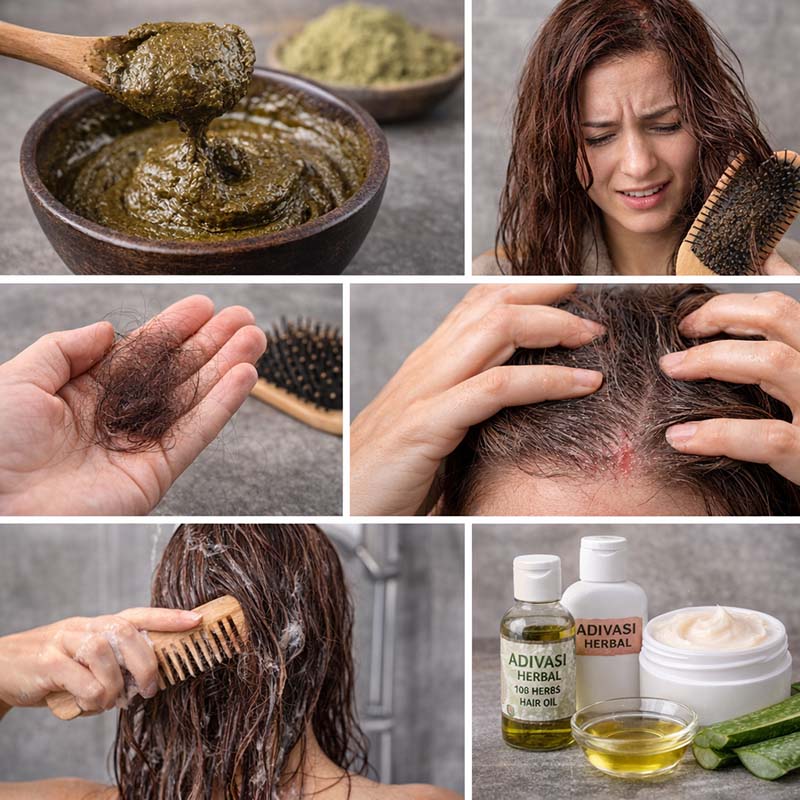
Henna is known to be " natural”, so many people are surprised when they notice after using it: Shedding, dryness, or frizz.
It is important to clarify a key point: often henna itself is not the direct cause of shedding from the roots, but Method of preparation, mixtures, duration of leaving, method of removal and combing, or sensitivity of the scalp It may make the hair break or the scalp become irritated, so it appears as a loss.
In this article we explain the causes precisely, and how to avoid them with practical steps.
Does henna actually cause hair loss?
Mostly Do not cause shedding from the roots For most people.
But it may cause:
- dryness Leads to breakage
- Irritation of the scalp When allergic reactions
- Heaviness/build-up If mixed with unsuitable substances
The precipitation is more pronounced.
Why does “shedding " occur after henna (8 common reasons)
1) cracking, not falling off
After henna the hair may become drier, and when combing it breaks.His mark: Short hair of different lengths + fluff.
2) leave henna too long
Prolonged duration may increase dryness, especially for already dry hair.
3) unsuitable henna mixtures
Some people confuse henna with:
- Strong aromatic substances
- Lemon in abundance
- Or non-customized materials
This may irritate the scalp and increase dryness.
4) allergy or irritation of the scalp
It may appear as itching and redness, and with itching the flaking increases.
5) not rinsing henna thoroughly
The remnants of henna may cause:
- Itching
- Husks
- Irritation
Especially if the scalp is oily.
6) violent combing after henna
Hair after henna is sensitive, and violently untangling it causes breakage.
7) use hot water during washing
Dryness increases and weakens the hair.
8) the problem already existed
Sometimes the shedding is due to tension or lack of elements, and the timing appeared after henna, and the person thought that it was the cause.
How to distinguish between Real shedding and breakage after henna?
- Real fallout: Full long hair
- Breakage: A lot of short hair + rough ends
If most of the hair is short, most often the problem is breaking due to dryness.
What to do after henna (A safe routine in two weeks)
1) very gentle washing
- Lukewarm water
- Shampoo that is gentle on the scalp only
- A good long rinse
2) strong moisturizing of the ends
- Balm after washing
- Moisturizing mask once a week
3) untangling the tangle inside the Shawar
- Balm + wide comb
- Do not comb wildly after going out
4) reduce heat
Two weeks after henna: reduce consultation and abundant as much as possible.
Is oil suitable after henna?
Yes, the best would be as Pre-poo before washing To moisturize and reduce breakage.
The method of Adivasi oil after henna
- 1-2 times a week
- Light scalp massage 3 minutes
- Duration of leaving:
- Oily scalp: 60-90 minutes
- Normal/dry: 2-3 hours
- Then a gentle wash + balm for the ends
Common mistakes to avoid
- Violent combing after henna
- Hot water
- Lemon abundantly mixed with henna
- Leave henna for very long hours
- Sleeping with heavy oils on oily scalp
When did a doctor retreat?
- Severe itching + painful redness
- Thick crusts or inflammation
- Persistent severe precipitation more than 2-3 months
- The appearance of clear voids
Frequently asked questions (FAQ)
Is henna suitable for all people?
Not for everyone. Some scalps are sensitive and may be irritated.
Does henna increase dryness?
Dryness may increase in some people, so moisturizing after henna is very important.
What hair needs to recover?
Texture improved in two weeks, and even greater improvement in 4 weeks with constant hydration.
Conclusion
If you notice shedding after henna, do not judge quickly. Often it is cracking, dryness or irritation due to the method of mixing or removal. Follow a gentle routine for two weeks and you will notice a clear difference.
Order Adivasi Herbal oil now:www.adivasi-herbal.com